Neutrino
"I have done a terrible thing. I have postulated a particle that cannot be detected." — Wolfgang Pauli, 1930
The Neutrino Hypothesis
What is Beta Decay?
Beta decay is a radioactive process where an unstable atomic nucleus emits a beta particle. In β⁻ decay, a neutron converts into a proton while emitting an electron. Before the neutrino hypothesis, the reaction was written as:
n → p⁺ + e⁻
p⁺ → n + e^+
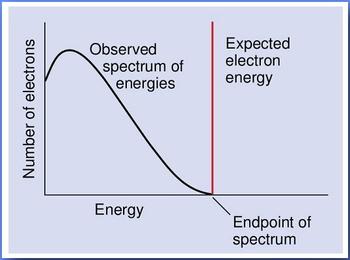 PLOT ENERGY and NO. of ELCETRONS
Three deep anomalies proved this two-body picture was fundamentally incomplete.
Anomaly 1 — The Continuous Energy Spectrum
Alpha and gamma decays produce particles with sharp, discrete energies. Beta electrons were expected to behave the same. Instead, Chadwick (1914) found electrons carrying a continuous range of energies, from zero up to a maximum value (Q-value).
Why this was a crisis: In a two-body decay, energy conservation demands a fixed electron energy. A continuous spectrum meant energy was disappearing — a direct violation of its conservation law. Niels Bohr briefly suggested abandoning energy conservation at the quantum level.
Anomaly 2 — Missing Linear Momentum
In a two-body decay n → p + e⁻, the proton and electron must recoil exactly back-to-back in the neutron's rest frame. Experiments found the recoil was not collinear — linear momentum was also unaccounted for.
Anomaly 3 — Angular Momentum (Spin) Imbalance
- Neutron: spin ½
- Proton (spin ½) + Electron (spin ½) → combined spin must be integer (0 or 1)
- But the neutron has half-integer spin ½
The reaction n → p + e⁻ cannot conserve angular momentum. A spin-½ particle must also be produced.
Pauli's Solution (1930)
On 4 December 1930, Wolfgang Pauli wrote his famous letter beginning "Dear Radioactive Ladies and Gentlemen..." proposing a neutral, spin-½, nearly massless particle emitted alongside the electron. He called it the "neutron" (later renamed neutrino by Fermi in 1934).
The corrected decay becomes:
n → p⁺ + e⁻ + ν̄ₑ
The antineutrino carries away the missing energy, momentum, and angular momentum — all three conservation laws are restored simultaneously.
Fermi's Theory of Beta Decay (1934)
Enrico Fermi formalized this into a complete quantum field theory, modelling beta decay as a four-fermion point interaction analogous to QED. His theory correctly predicted the shape of the continuous electron spectrum, introduced the concept of the weak nuclear force, and laid the foundation for the electroweak sector of the Standard Model.
Properties of the Neutrino
| Property | Value / Description |
|---|---|
| Electric charge | 0 (neutral) |
| Spin | ½ (fermion) |
| Mass | Non-zero but tiny — sum of all flavors < 0.12 eV/c² |
| Lepton number | +1 (ν), −1 (ν̄) |
| Interaction | Weak nuclear force and gravity only |
| Helicity | Always left-handed (ν); always right-handed (ν̄) |
| Antiparticle | Antineutrino ν̄ (possibly itself — Majorana question open) |
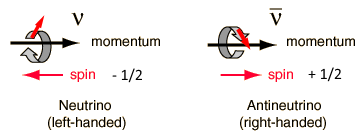 Neutrino and Anti Neutrino
The Ghost Particle
Neutrinos interact only via the weak force. Their mean free path through lead is approximately one light-year. Roughly 65 billion solar neutrinos pass through every square centimeter of your body every second, completely undetected.
Mass — A Surprise from Oscillations
The Standard Model originally assumed neutrinos were massless. Neutrino oscillation experiments proved they must have small non-zero masses. The Solar Neutrino Problem — Ray Davis's Homestake experiment detected only ~⅓ of predicted solar νₑ — was resolved when SNO showed the missing νₑ had oscillated into other flavors during their 8-minute journey from the Sun.
Nobel Prize in Physics 2015: Takaaki Kajita (Super-Kamiokande) and Arthur McDonald (SNO).
The Three Neutrino Flavors
| Flavor | Symbol | Associated Lepton | First Detected | Key Source |
|---|---|---|---|---|
| Electron neutrino | νₑ | Electron (e⁻) | 1956 | Nuclear reactors, Sun |
| Muon neutrino | νμ | Muon (μ⁻) | 1962 | Pion decay, atmosphere |
| Tau neutrino | ντ | Tau (τ⁻) | 2000 | Tau lepton decay |
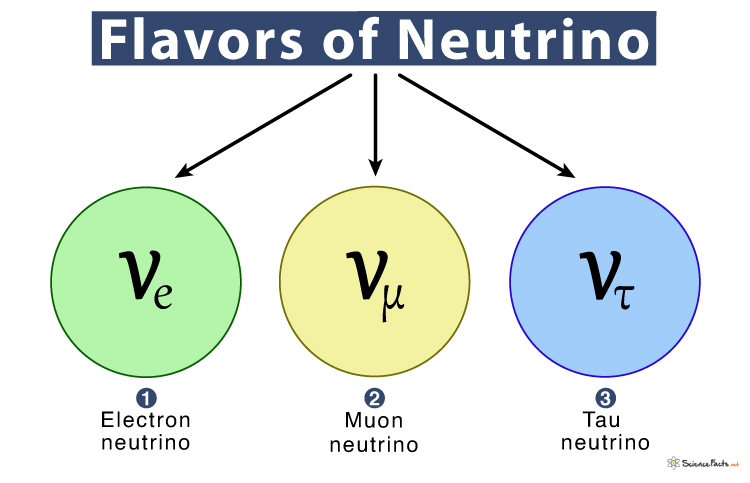 Flavors of Neutrinos
Electron Neutrino (νₑ)
Produced copiously in nuclear reactors and in the Sun's pp-chain. First detected in 1956 by Cowan and Reines at the Savannah River nuclear reactor using inverse beta decay (Nobel 1995 to Reines).
Muon Neutrino (νμ)
Produced in pion decay: π⁺ → μ⁺ + νμ, followed by μ⁺ → e⁺ + νₑ + ν̄μ. In 1962 at Brookhaven, Lederman, Schwartz, and Steinberger proved νμ ≠ νₑ — showing νμ interactions produce only muons, never electrons — demonstrating separate lepton flavor conservation (Nobel 1988). Atmospheric νμ were central to Super-Kamiokande's 1998 oscillation discovery.
Tau Neutrino (ντ)
Predicted after Martin Perl discovered the tau lepton at SLAC in 1975 (Nobel 1995). The tau's extremely short lifetime (~3 × 10⁻¹³ s) makes ντ production rare. First directly detected in 2000 by the DONUT experiment at Fermilab using nuclear emulsions.
Inverse Beta Decay
The Reaction
Inverse beta decay (IBD) is the time-reversal of ordinary β⁻ decay:
Regular β⁻ decay:    n  →  p  +  e⁻  +  ν̄ₑ
Inverse beta decay:  ν̄ₑ + p  →  n  +  e⁺
The Delayed Coincidence Signature
IBD produces two temporally separated signals, enabling powerful background rejection:
- Prompt: The positron annihilates → two 511 keV gamma rays (back-to-back)
- Delayed (2–200 μs): The neutron is captured by Cd/Gd/H → characteristic gamma ray
This technique was used by Cowan and Reines in 1956 for the first neutrino detection.
Energy Threshold
E_threshold = (mₙ + mₑ − mₚ)c² + 2mₑc² ≈ 1.806 MeV
Only ν̄ₑ with energy > 1.806 MeV can trigger IBD. Reactor antineutrinos (2–8 MeV) comfortably exceed this.
Modern IBD Experiments
| Experiment | Purpose |
|---|---|
| KamLAND (Japan) | Reactor oscillations, geo-neutrinos |
| Daya Bay (China) | Precision θ₁₃ measurement |
| RENO (South Korea) | Reactor oscillation |
| Double Chooz (France) | θ₁₃ near/far detector |
| Kamiokande-II / IMB | Detected SN 1987A supernova neutrinos |
Neutrino vs. Antineutrino
| Property | Neutrino (ν) | Antineutrino (ν̄) |
|---|---|---|
| Lepton number | +1 | −1 |
| Helicity | Left-handed (h = −1) | Right-handed (h = +1) |
| Produced in | β⁺ decay, electron capture | β⁻ decay |
| Triggers IBD? | No | Yes (ν̄ₑ + p → n + e⁺) |
Lepton Number Conservation
In β⁻ decay, lepton number is balanced:
n  →  p  +  e⁻  +  ν̄ₑ
Lₑ:  0  =  0  +  (+1)  +  (−1)  ✓
The Majorana Question
Dirac neutrino: ν and ν̄ are genuinely distinct, distinguished by conserved lepton number. Right-handed neutrinos exist but are sterile.
Majorana neutrino: The neutrino is its own antiparticle (ν = ν̄). The only distinction is helicity — not a fundamental quantum number. This would allow neutrinoless double beta decay (0νββ):
(A, Z) → (A, Z+2) + 2e⁻ [ΔL = 2; no neutrinos emitted]
Not yet observed. Experiments KamLAND-Zen, GERDA, CUORE, and nEXO are searching.
Helicity & Opposite Spin
Definition of Helicity
Helicity is the projection of a particle's spin onto its direction of momentum:
h = (σ · p̂) = +1  →  right-handed  (spin ∥ momentum)
h = (σ · p̂) = −1  →  left-handed   (spin antiparallel to momentum)
The Universal Helicity Rule
All neutrinos are left-handed (h = −1).
All antineutrinos are right-handed (h = +1).
Confirmed by the Goldhaber experiment (1958): measuring the circular polarization of gamma rays following electron capture in ¹⁵²Eu → ¹⁵²Sm* + νₑ, Goldhaber, Grodzins, and Sunyar inferred that neutrinos are left-handed.
Why ν and ν̄ Have "Opposite Spins"
A νₑ traveling to the right has spin pointing left (antiparallel) → left-handed.
A ν̄ₑ traveling to the right has spin pointing right (parallel) → right-handed.
Applying a parity transformation to a left-handed neutrino produces a right-handed neutrino — but right-handed neutrinos do not interact weakly and may not exist as active particles. This is the root of parity violation.
Chirality vs. Helicity
| Chirality | Helicity | |
|---|---|---|
| Definition | Lorentz-invariant; eigenstate of γ⁵ | Projection of spin on momentum |
| Massless limit | = Helicity | = Chirality |
| Massive particle | Frame-independent | Can be flipped by Lorentz boost |
| Weak coupling | Left-chiral fermions only | ~Left-helical for near-massless ν |
For neutrinos (mν ≪ Eν), chirality ≈ helicity to extraordinary precision. The weak force fundamentally couples to left-chiral fermion fields — encoded in the V−A structure.
Historical Timeline
| Year | Event |
|---|---|
| 1914 | Chadwick observes continuous β spectrum — first anomaly |
| 1930 | Pauli proposes the neutrino in his famous letter |
| 1934 | Fermi's theory of beta decay; names it "neutrino" |
| 1956 | Cowan & Reines first detect ν̄ₑ; Lee & Yang predict P-violation |
| 1957 | Wu experiment confirms P-violation; Goldhaber measures ν helicity |
| 1962 | Lederman, Schwartz, Steinberger prove νμ ≠ νₑ (Nobel 1988) |
| 1975 | Perl discovers tau lepton; ντ predicted |
| 1998 | Super-Kamiokande confirms atmospheric neutrino oscillations |
| 2000 | DONUT directly detects ντ at Fermilab |
| 2015 | Nobel Prize: Kajita & McDonald for oscillation discovery |
Sources
- Pauli, W. (1930). Letter to the Physical Society of Tübingen. Original neutrino proposal.
- Fermi, E. (1934). Versuch einer Theorie der β-Strahlen. Zeitschrift für Physik, 88, 161–177.