Four Fundamental Forces of Nature
The universe is governed by four fundamental forces of nature. These forces control every interaction in nature — from the motion of galaxies to the behavior of elementary particles.
Each force differs in strength, range, and mechanism, yet together they form the foundation of all physical phenomena.
#1. Gravitational Force
The gravitational force is the force of attraction between any two masses. It governs large-scale structures like planets, stars, and galaxies. Of all the fundamental forces, gravity is the weakest — yet it has an infinite range and dominates the universe at cosmic scales because it is always attractive and acts on all matter.
 Gravity — Earth-Moon System
Mathematical Expression
Newton's Law of Universal Gravitation:
Where:
- = gravitational force (Newtons)
- = gravitational constant
- = masses of the two objects
- = distance between their centres
Key behaviour:
- Force increases proportionally with mass
- Force decreases with the square of the distance
- Always attractive — never repulsive
Modern Theory — General Relativity
Einstein's General Relativity revolutionised our understanding: gravity is not merely a force but a curvature of spacetime caused by mass and energy.
 Einstein's Spacetime Curvature
The Einstein Field Equations:
Where:
- = Einstein tensor (describes spacetime curvature)
- = stress-energy tensor (describes matter and energy)
- = speed of light
Key predictions of General Relativity:
- Gravitational lensing — light bends around massive objects
- Gravitational time dilation — time runs slower near large masses
- Black holes — regions where spacetime curvature becomes infinite
- Gravitational redshift — light loses energy escaping a gravitational field
Examples
- Earth pulling objects downward (everyday weight)
- Planets orbiting the Sun
- Tides caused by the Moon's gravitational pull
#2. Electromagnetic Force
The electromagnetic force acts between electrically charged particles. It is responsible for electricity, magnetism, visible light, chemical bonding, and the structure of atoms. It is vastly stronger than gravity at the atomic scale and has an infinite range.
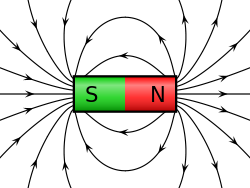 Electromagnetic Force
Coulomb's Law
The force between two point charges:
Where:
- (Coulomb's constant)
- = electric charges
- = separation between charges
Behaviour:
- Like charges repel
- Opposite charges attract
- Much stronger than gravity at the atomic scale
Lorentz Force
A moving charge in combined electric and magnetic fields experiences:
Where:
- = electric field
- = magnetic field
- = velocity of the charge
This equation is the foundation of electric motors, generators, and particle accelerators.
Maxwell's Equations
James Clerk Maxwell unified electricity and magnetism into a single framework with four elegant equations:
1. Gauss's Law — electric charges produce electric fields
2. Gauss's Law for Magnetism — there are no magnetic monopoles
3. Faraday's Law — a changing magnetic field induces an electric field
4. Ampère–Maxwell Law — electric currents and changing electric fields produce magnetic fields
What these equations tell us:
- Electric charges create electric fields around them
- Changing magnetic fields generate electric fields (basis of induction)
- Light is an electromagnetic wave — a self-propagating oscillation of electric and magnetic fields
Quantum Electrodynamics (QED)
QED is the quantum field theory of the electromagnetic interaction, and the most precisely verified theory in all of physics.

Core idea: Electromagnetic interactions occur via the exchange of virtual photons — the force carrier of the electromagnetic field.
- A charged particle (e.g. an electron) emits a virtual photon
- Another charged particle absorbs that photon
- This exchange produces the observed force
This is the force carrier mechanism, a concept central to all quantum field theories.
Why QED matters:
- Explains atomic structure, spectral lines, and chemical bonding
- Describes how light interacts with matter
- Its predictions match experiments to more than 10 significant figures
Examples
- Electric current flowing through a wire
- Permanent magnets attracting iron
- Chemical bonding between atoms
- Propagation of light through space
#3. Strong Nuclear Force
The strong nuclear force is the strongest of the four fundamental forces. It operates at subatomic scales, binding quarks together to form protons and neutrons, and holding atomic nuclei together despite the electromagnetic repulsion between protons.
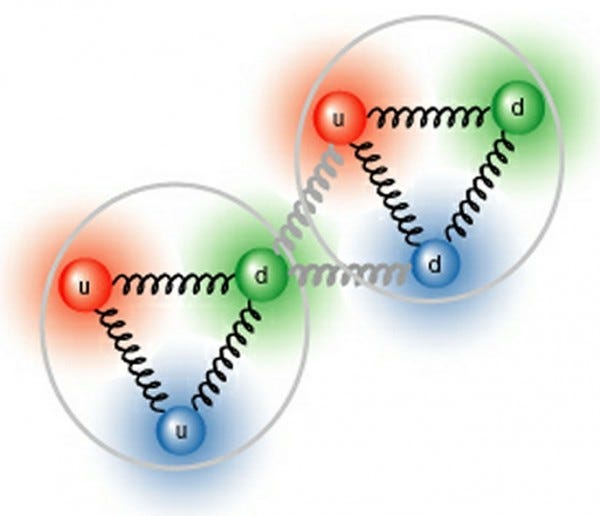 Strong Nuclear Force
(A) Fundamental Strong Force — Color Force
At the deepest level, the strong force acts between quarks and is described by Quantum Chromodynamics (QCD).
Key concept — Color Charge:
- Quarks carry a property called color charge (named by analogy, not actual colour): red, green, or blue
- Gluons are the force carriers that exchange color charge between quarks
- Stable particles (like protons) must be color-neutral (all three colors combined)
A remarkable feature of QCD is confinement: quarks can never be isolated — the force between them actually increases with distance, like a stretched rubber band. Breaking them apart just creates new quark pairs.
(B) Residual Strong Force — Nuclear Force
At the scale of the atomic nucleus, the strong force manifests as the residual strong force binding protons and neutrons (collectively called nucleons) together.
Mediated by: Virtual pions (π mesons)
Range: Approximately 1–3 femtometres
Mechanism — Particle Exchange:
- A proton emits a virtual pion
- A nearby neutron absorbs it
- Continuous pion exchange produces a strong attractive force
This is called particle exchange interaction, and it is the basis for understanding nuclear binding.
Yukawa Potential
The potential energy of the residual strong force, described by Hideki Yukawa in 1935:
Where:
- = coupling strength constant
- = inverse of the force range (related to pion mass)
- = separation distance
What this tells us:
- The exponential term ensures the force drops off very sharply — explaining the extremely short range of the nuclear force
- Within range, it is enormously attractive
Why Is the Nucleus Stable?
Two competing forces act inside the nucleus:
- Electromagnetic force — protons repel each other (same charge)
- Strong nuclear force — overcomes this repulsion and binds nucleons together
This balance explains why nuclei are stable — up to a point. Very large nuclei (like uranium) become unstable because the electromagnetic repulsion across the larger nucleus eventually begins to overpower the short-range strong force.
Examples
- Binding of protons and neutrons inside the nucleus
- Release of nuclear energy in reactors
- Nuclear fission (splitting of heavy nuclei)
- Nuclear fusion (merging of light nuclei in stars)
#4. Weak Nuclear Force
The weak nuclear force is unique among the four forces: it does not simply attract or repel — it causes particle transformation. It is responsible for radioactive beta decay and plays a critical role in the nuclear fusion reactions that power stars.
Feynman Diagram — Beta Decay
Beta Decay
The most well-known weak interaction — a neutron transforms into a proton:
What happens at the quark level:
- A down quark inside the neutron transforms into an up quark
- This changes a neutron into a proton
- An electron () and an antineutrino () are emitted
This process changes the very identity of a particle — something no other force can do.
How the Weak Force Works
The weak force is mediated by three massive gauge bosons:
| Boson | Charge | Role |
|---|---|---|
| +1 | Mediates positive charge change | |
| −1 | Mediates negative charge change | |
| 0 | Mediates neutral weak interactions |
The and bosons are very massive (around 80–91 GeV/c²), which is why the weak force has such an extremely short range.
Key ability: The weak force allows quark flavor change — e.g. a down quark becoming an up quark. No other force permits this.
Role in Stellar Fusion
Inside stars like the Sun, the weak force enables the first critical step of hydrogen fusion:
- Two protons come together
- The weak force converts one proton into a neutron (via emission)
- A deuterium nucleus (one proton + one neutron) is formed
- A positron and a neutrino are released
Without the weak interaction, this step could not occur — stars could not shine, and the universe as we know it would not exist.
Strength and Range
Fermi constant (measure of weak interaction strength):
Range: Extremely short — approximately m (about 0.1% the diameter of a proton).
Why the Weak Force Matters
- Enables fusion reactions inside stars — the energy source of the universe
- Produces neutrinos — nearly massless particles that pass through ordinary matter
- Responsible for radioactivity — the decay of unstable isotopes
- Essential for nucleosynthesis — the creation of elements in stars and supernovae
#Key Concepts
1. Unification of Forces
Physics has long sought to unite the fundamental forces into a single framework:
- Electroweak Theory (Glashow, Salam, Weinberg — Nobel Prize 1979): Successfully unified the electromagnetic and weak forces into a single electroweak force at high energies
- Grand Unified Theories (GUTs): Attempt to further unify the electroweak force with the strong force — not yet experimentally confirmed
- Theory of Everything: Would include gravity — the ultimate goal of theoretical physics, still an open problem
2. Force Carriers (Gauge Bosons)
Every fundamental force is mediated by a corresponding carrier particle:
| Force | Carrier Particle | Mass | Range |
|---|---|---|---|
| Gravitational | Graviton (hypothetical) | 0 | Infinite |
| Electromagnetic | Photon () | 0 | Infinite |
| Strong (color) | Gluon () | 0 | m |
| Weak | , , | ~80–91 GeV/c² | m |
The graviton has been theorised but never detected — quantising gravity remains one of the greatest unsolved problems in physics.
3. Relative Strength
The four forces differ enormously in strength. Taking the strong force as a baseline:
Gravity is approximately times weaker than the strong force — yet it dominates the universe at large scales because it is always attractive and acts over infinite range on all massive objects.
| Force | Relative Strength | Range |
|---|---|---|
| Strong | m | |
| Electromagnetic | Infinite | |
| Weak | m | |
| Gravitational | Infinite |
#Conclusion
The four fundamental forces together account for every physical interaction in the universe:
- Gravity → governs the large-scale structure of the cosmos — planets, stars, galaxies, and black holes
- Electromagnetism → governs atoms, light, chemistry, and all of everyday technology
- Strong nuclear force → binds quarks into protons and neutrons, and holds nuclei together
- Weak nuclear force → enables particle transformation, radioactive decay, and stellar fusion
Understanding these forces is essential to exploring:
- The origin of the universe (Big Bang cosmology)
- The structure of matter (particle physics and the Standard Model)
- The future of physics — a Grand Unified Theory or Theory of Everything that brings all four forces under one framework