Antimatter consists of antiparticles — particles that have the same mass and spin as their
corresponding matter particles, but with certain quantum numbers reversed (charge, lepton number,
baryon number, magnetic moment direction). When a particle and its antiparticle meet, they
annihilate, converting their combined rest-mass energy into photons (or other particle–antiparticle
pairs).
Key historical note: The existence of antimatter was first predicted by Paul Dirac in 1928
through his relativistic wave equation, and the positron (antielectron) was experimentally
discovered by Carl Anderson in 1932.
Each photon carries energy E=mec2=0.511MeV (in the centre-of-mass frame), emitted
back-to-back to conserve momentum.
Pair production (inverse process):
γ⟶e−+e+
Requires photon energy Eγ≥2mec2=1.022MeV (in the presence of a nucleus for
momentum conservation).
3.2 Proton ↔ Antiproton
p⟷pˉ
Property
Proton p
Antiproton pˉ
Mass
mp=1.673×10⁻²⁷kg
same
Charge
+e
−e
Spin
21
21
Baryon Number B
+1
−1
Quark content
uud
uˉuˉdˉ
Annihilation:
p+pˉ⟶mesons (e.g., pions)orγ-rays
p+pˉ⟶π++π−+π0+⋯
Threshold energy for antiproton production:
Ethreshold=4mpc2≈3.76GeV
The antiproton was discovered at the Bevatron accelerator (Berkeley) in 1955 by Segrè and Chamberlain.
3.3 Neutron ↔ Antineutron
n⟷nˉ
Property
Neutron n
Antineutron nˉ
Mass
mn=1.675×10⁻²⁷kg
same
Electric Charge
0
0
Spin
21
21
Magnetic Moment
μn=−1.913μN
+1.913μN (opposite)
Baryon Number B
+1
−1
Quark content
udd
uˉdˉdˉ
Although the neutron is electrically neutral, its magnetic moment is opposite for the
antineutron, making them distinguishable. The antineutron was discovered in 1956.
Annihilation:
n+nˉ⟶π++π−+π0+⋯
AntiProton AntiNeutron
3.4 Photon ↔ Itself (Self-Conjugate)
γ⟷γ
The photon is its own antiparticle. It has:
Zero charge Q=0
Zero mass
Spin s=1
Zero lepton number, zero baryon number
Since all additive quantum numbers are zero, the photon satisfies γˉ=γ.
C∣γ⟩=−∣γ⟩(charge conjugation eigenvalue=−1)
3.5 Muon and Antimuon
μ−⟷μ+
Property
Muon μ−
Antimuon μ+
Mass
105.66MeV/c2
same
Charge
−e
+e
Spin
21
21
Muon Lepton Number Lμ
+1
−1
Lifetime
τ≈2.197μs
same
Decay:
μ−⟶e−+νˉe+νμ
μ+⟶e++νe+νˉμ
Each decay conserves both electron and muon lepton numbers separately.
3.6 Pion (Pi Meson) ↔ Antipion
Pions are the lightest mesons, composed of quark–antiquark pairs:
Pion
Quark Content
Charge
Mass
π+
udˉ
+e
139.57MeV/c2
π− (antiparticle of π+)
duˉ
−e
139.57MeV/c2
π0
21(uuˉ−ddˉ)
0
134.98MeV/c2
π+⟷π−
The π0 is self-conjugate (its own antiparticle), similar to the photon.
At the fundamental level, particle–antiparticle annihilation is quark–antiquark annihilation
mediated by gauge bosons. For example, in proton–antiproton annihilation:
u+uˉ⟶g⟶q+qˉ(via gluon g)
u+uˉ⟶γ or Z0(electroweak)
The general quark annihilation vertex (QCD):
qi+qˉi⟶gawith amplitude∝gsTija
where gs is the strong coupling constant and Tija are the SU(3) colour generators.
Cross-section for qqˉ annihilation into lepton pair (Drell–Yan):
σ^(qqˉ→ℓ+ℓ−)=3s^4πα2eq2⋅Nc−1
where s^ is the partonic centre-of-mass energy squared, eq is the quark charge, and Nc=3
is the colour factor.
A baryon is a hadron composed of three quarks (qqq), bound together by the strong force
(QCD). Baryons carry baryon number B=+1.
B=31(nq−nqˉ)
Each quark contributes B=+31; each antiquark contributes B=−31.
The antidbaryon is the corresponding antiparticle with three antiquarks (qˉqˉqˉ)
and B=−1.
Baryon AntiBaryon
Associated Baryon Particles
Baryon
Symbol
Quark Content
Charge
Mass (MeV/c2)
B
Proton
p
uud
+1
938.3
+1
Neutron
n
udd
0
939.6
+1
Lambda
Λ0
uds
0
1115.7
+1
Sigma-plus
Σ+
uus
+1
1189.4
+1
Sigma-zero
Σ0
uds
0
1192.6
+1
Sigma-minus
Σ−
dds
−1
1197.4
+1
Xi (Cascade)
Ξ0
uss
0
1314.9
+1
Xi-minus
Ξ−
dss
−1
1321.7
+1
Omega-minus
Ω−
sss
−1
1672.5
+1
Delta baryons
Δ++,+,0,−
various
+2 to −1
∼1232
+1
Each of these has a corresponding antibaryon with all quarks replaced by antiquarks and
B=−1, e.g., pˉ, nˉ, Λˉ0, Ωˉ+, etc.
Baryon number conservation:
ΔB=0in all known interactions
(Possible violation only in hypothetical proton decay or baryogenesis scenarios.)
Dirac Hole Theory
The Dirac Equation
In 1928, Paul Dirac formulated a relativistic quantum mechanical equation for the electron:
(iℏγμ∂μ−mc)ψ=0
where γμ are the 4×4 Dirac gamma matrices satisfying the Clifford algebra:
{γμ,γν}=γμγν+γνγμ=2gμνI4×4
The energy solutions of the Dirac equation are:
E=±(pc)2+(mc2)2
This yields both positive and negative energy eigenvalues. The negative-energy solutions
presented a conceptual crisis: classically, an electron could cascade down to −∞ energy.
The Dirac Sea
Dirac resolved this using the Pauli Exclusion Principle (valid for fermions like electrons):
Dirac's Hole Hypothesis: The vacuum (ground state) consists of an infinite "sea" of
negative-energy states, all completely filled. Since the Pauli principle forbids two fermions in
the same state, real electrons cannot fall into these occupied negative-energy states.
∣0⟩Dirac=∏E<0aE,s†∣0⟩bare
Holes as Antiparticles
If a negative-energy electron (energy −∣E∣, charge −e, momentum −p) is excited out
of the Dirac sea into a positive-energy state, it leaves behind a hole.
The hole behaves as a particle with:
Energy: +∣E∣ (absence of −∣E∣ energy raises the sea's energy by +∣E∣)
Charge: +e (absence of −e charge gives net +e)
Momentum: +p
Spin: +21 (same as electron)
Hole≡Positron e+
Pair creation in hole theory:
γ⟶e− (excited from sea)+hole (e+)
Pair annihilation:
e− falls into hole⟶γ+γ
Limitation of Hole Theory: It only works for fermions (Pauli exclusion). For bosons
(integer spin), there is no exclusion principle to fill the sea. This inadequacy led to the
development of Quantum Field Theory.
Dirac Hole Model
Modern Theory of Antiparticles — Quantum Field Theory
In Quantum Field Theory (QFT), particles and antiparticles are both excitations of the same
underlying quantum field. There is no Dirac sea; instead, the field is quantised with creation and annihilation operators.
Quantum Field
Electron Proton Field
The Electron Field
The electron is described by a Dirac spinor fieldψ(x), which upon canonical quantisation
is expanded as:
Crossing symmetry is a fundamental property of scattering amplitudes in QFT. It states that the
amplitude for a process involving a particle in the initial state is related to the amplitude for
the same process with the corresponding antiparticle in the final state (with reversed
4-momentum), and vice versa.
Formally, for an S-matrix element:
M(A+B→C+D)=M(B+Cˉ→Aˉ+D)
by analytically continuing the external momenta.
The Three Related Channels
Consider the generic 2→2 scattering. Crossing symmetry connects three "channels":
Channel
Process
Mandelstam Variable
s-channel
A+B→C+D
s=(pA+pB)2
t-channel
A+Cˉ→Bˉ+D
t=(pA−pC)2
u-channel
A+Dˉ→Bˉ+C
u=(pA−pD)2
The three Mandelstam variables satisfy:
s+t+u=∑imi2
The same Feynman amplitude M(s,t,u), when analytically continued, describes all
three channels.
Example: Compton Scattering vs. Pair Annihilation
s-channel (Compton scattering):
e−+γ⟶e−+γ
t-channel (related by crossing):
e−+e+⟶γ+γ(pair annihilation)
These two processes share the same Feynman diagrams — the difference is only which legs are
"crossed" (moved from initial to final state with reversed momentum):
Me−γ→e−γ(s,t)=Me−e+→γγ(t,s)
Mathematical Statement
If a particle A with momentum p is in the initial state, crossing symmetry allows us to
replace it with its antiparticle Aˉ with momentum −p in the final state:
Initial state particle A(p)⟷Final state antiparticle Aˉ(−p)
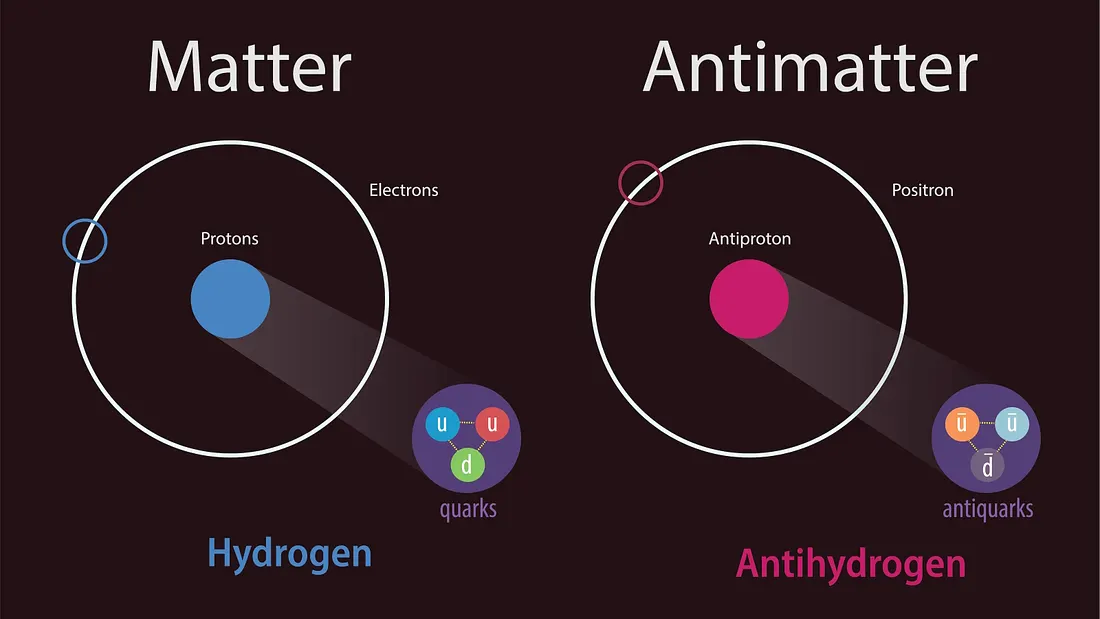 Anti Hydrogen model
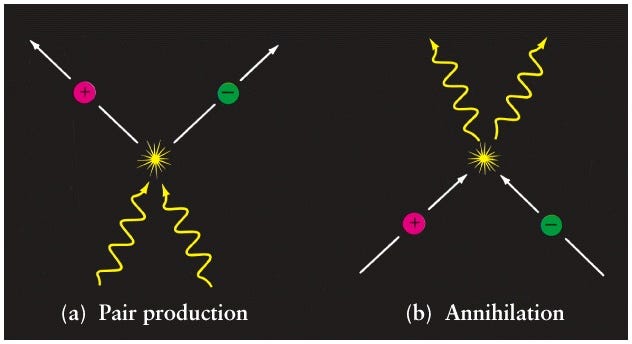 Annihilation
 AntiProton AntiNeutron
 Baryon AntiBaryon
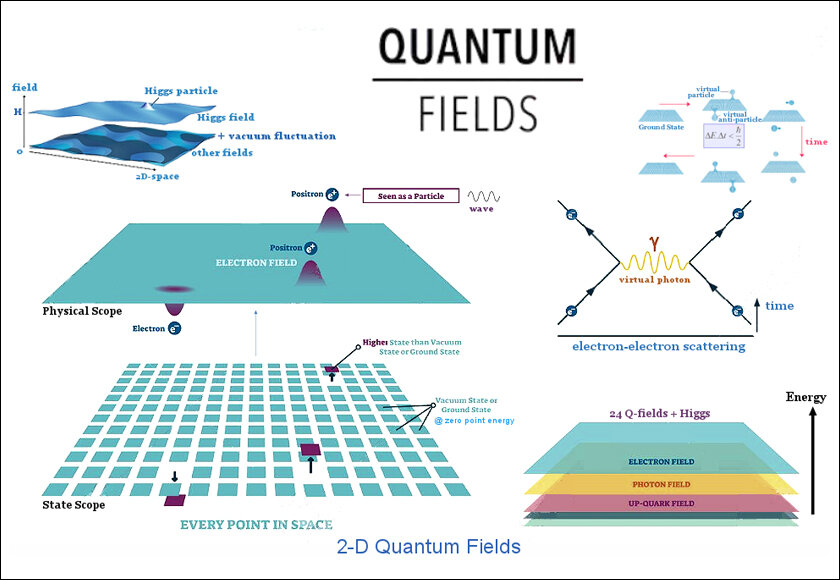 Quantum Field
 Electron Proton Field