Sieve of Eratosthenes
The Sieve of Eratosthenes is one of the oldest and most elegant algorithms in computer science,
dating back to ancient Greece (~240 BC). It efficiently finds all prime numbers up to a given
limit n by iteratively marking the multiples of each prime as composite (non-prime).
#1.1 Core Idea
Start with all numbers marked as prime. For each prime
pfound, mark all its multiples (starting fromp²) as not prime. Whatever remains unmarked is a prime.
This simple "sieving" process eliminates composites in bulk — that's what makes it fast.
#1.2 Step-by-Step Example
Let's find all primes up to n = 30:
Initial:  2  3  4  5  6  7  8  9  10  11  12  13  14  15  16  17  18  19  20  21  22  23  24  25  26  27  28  29  30

Step 1 (p=2): Mark 4, 6, 8, 10, 12, 14, 16, 18, 20, 22, 24, 26, 28, 30 ❌
Step 2 (p=3): Mark 9, 15, 21, 27 ❌
Step 3 (p=5): Mark 25 ❌
Step 4 (p=7): 7² = 49 > 30, so stop.

✅ Primes: 2, 3, 5, 7, 11, 13, 17, 19, 23, 29
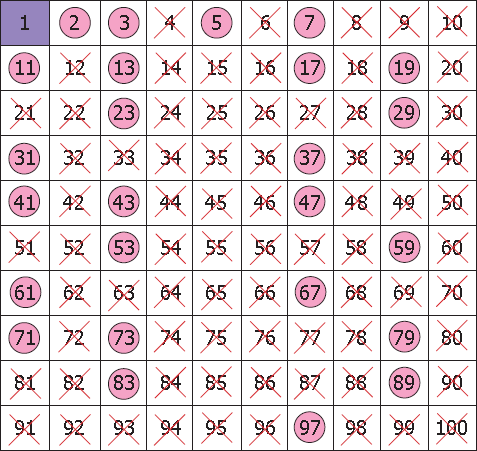 Sieve of Eratosthenes
#1.3 Implementation
Python
def sieve_of_eratosthenes(n: int) -> list[int]:
    is_prime = [True] * (n + 1)
    is_prime[0] = is_prime[1] = False  # 0 and 1 are not prime

    p = 2
    while p * p <= n:
        if is_prime[p]:
            # Mark all multiples of p starting from p²
            for multiple in range(p * p, n + 1, p):
                is_prime[multiple] = False
        p += 1

    return [i for i, prime in enumerate(is_prime) if prime]

# Example
print(sieve_of_eratosthenes(30))
# Output: [2, 3, 5, 7, 11, 13, 17, 19, 23, 29]
JavaScript
function sieveOfEratosthenes(n) {
  const isPrime = new Array(n + 1).fill(true);
  isPrime[0] = isPrime[1] = false;

  for (let p = 2; p * p <= n; p++) {
    if (isPrime[p]) {
      for (let multiple = p * p; multiple <= n; multiple += p) {
        isPrime[multiple] = false;
      }
    }
  }

  return isPrime.reduce((primes, val, idx) => {
    if (val) primes.push(idx);
    return primes;
  }, []);
}

console.log(sieveOfEratosthenes(30));
// Output: [2, 3, 5, 7, 11, 13, 17, 19, 23, 29]
C++
#include <iostream>
#include <vector>
using namespace std;

vector<int> sieve(int n) {
    vector<bool> is_prime(n + 1, true);
    is_prime[0] = is_prime[1] = false;

    for (int p = 2; (long long)p * p <= n; p++) {
        if (is_prime[p]) {
            for (int multiple = p * p; multiple <= n; multiple += p)
                is_prime[multiple] = false;
        }
    }

    vector<int> primes;
    for (int i = 2; i <= n; i++)
        if (is_prime[i]) primes.push_back(i);

    return primes;
}#1.4 Complexity Analysis
| Metric | Value | Notes |
|---|---|---|
| Time Complexity | O(n log log n) | Near-linear; very fast in practice |
| Space Complexity | O(n) | Boolean array of size n+1 |
| Best For | n ≤ 10⁷ – 10⁸ | Works well within typical memory limits |
Why
p * p? When we reachp, all smaller multiples ofp(like2p,3p, ...) have already been marked by earlier primes. So we safely start fromp².
#1.5 Common DSA Use Cases
The Sieve is frequently used as a preprocessing step in competitive programming and DSA problems:
- Finding prime factors — precompute smallest prime factor (SPF) sieve
- Counting primes in a range — prefix sum over sieve array
- Goldbach's conjecture problems — express even numbers as sum of two primes
- Prime sums / products — precomputed prime list speeds lookups
- Segmented Sieve — for very large
nwhere memory is a concern
#1.6 Variants
1.6.1 Segmented Sieve
Used when n is very large (e.g., n = 10¹²). Divides the range into segments of size √n
and applies the sieve segment by segment, keeping memory usage at O(√n).
1.6.2 Linear Sieve
A modification that achieves O(n) time by ensuring each composite is crossed out exactly once using the smallest prime factor technique.
def linear_sieve(n):
    lp = [0] * (n + 1)   # Smallest prime factor
    primes = []

    for i in range(2, n + 1):
        if lp[i] == 0:
            lp[i] = i
            primes.append(i)
        for p in primes:
            if p > lp[i] or i * p > n:
                break
            lp[i * p] = p

return primes#1.7 Limitations
- Memory intensive for very large
n(e.g.,n = 10⁹requires ~1 GB for a bool array). Use a segmented or bitset sieve in such cases. - Not suitable for checking a single large number — use Miller-Rabin primality test instead.
#1.8 Summary
| Property | Detail |
|---|---|
| Type | Sieve / Marking Algorithm |
| Input | Integer n |
| Output | All primes ≤ n |
| Time Complexity | O(n log log n) |
| Space | O(n) |
| Practical Limit | n ≤ 10⁷ (standard), 10⁸ with bitset |
| Key Trick | Start marking from p², not 2p |
Pro Tip: In competitive programming, precompute the sieve at the start
for the maximum constraint (n = 10^6or10^7), then answer all prime-related queries in O(1).
#1.8 Sources
Source: GeeksforGeeks - Sieve of Eratosthenes
Leetcode : 2523. Closest Prime Numbers in Range