The Historical Journey of Large Language Models
#Stage 1 — Encoder-Decoder Architecture
Timeline: 2014
The foundation of modern NLP. An encoder compresses input text into a fixed-size vector, and a decoder generates output from it — purpose-built for sequence-to-sequence tasks like machine translation. Built on LSTMs (Long Short-Term Memory networks).
How it works
 Encoder - Decoder model
The Problem
Compressing an entire sentence into a single fixed-size vector caused critical information loss on long sequences — known as the bottleneck problem.
| Strength | Limitation |
|---|---|
| Handled variable-length sequences | Fixed vector = information compression |
| Good for short sentences | Performance degraded on long inputs |
| Foundation for seq2seq tasks | No way to "look back" at earlier tokens |
#Stage 2 — Attention Mechanism
Timeline: 2014 - 2015
Proposed as a direct fix to the encoder bottleneck. Instead of relying on one compressed vector, attention lets the decoder look back at all encoder hidden states and assign relevance weights — focusing the model's "spotlight" on the most important parts of the input at each decoding step.
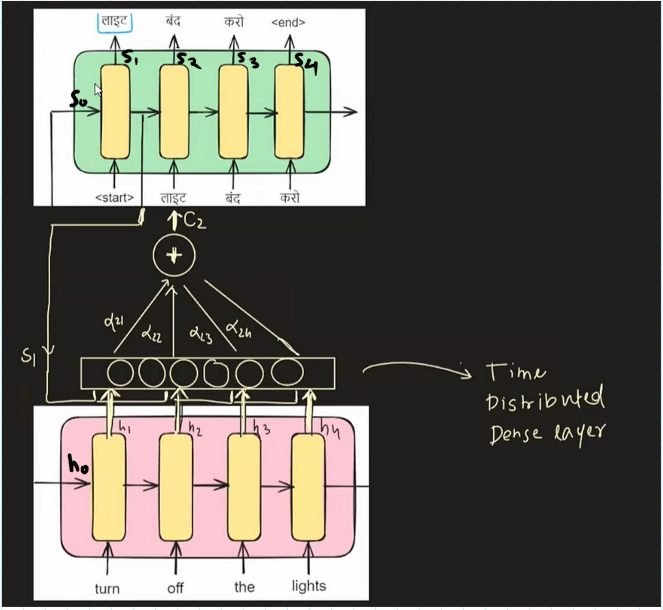 Attention Mechanism
The Trade-off
Attending to every token pair means O(n²) computational complexity. For long sequences, this becomes extremely expensive.
#Stage 3 — Transformers
Timeline: 2017
"Attention Is All You Need" — Vaswani et al., 2017
The architectural revolution. Transformers discarded RNNs entirely and relied solely on self-attention, enabling every token to relate to every other token in a single pass.
Why It Changed Everything
- Parallel processing — all tokens processed simultaneously, not sequentially
- Dramatically faster training at scale
- Positional encodings preserve word-order information without recurrence
- Became the backbone of virtually every modern AI language system
Architecture at a Glance
Input Tokens
    ↓
Positional Encoding
    ↓
[Multi-Head Self-Attention] × N
    ↓
Feed-Forward Network
    ↓
Output
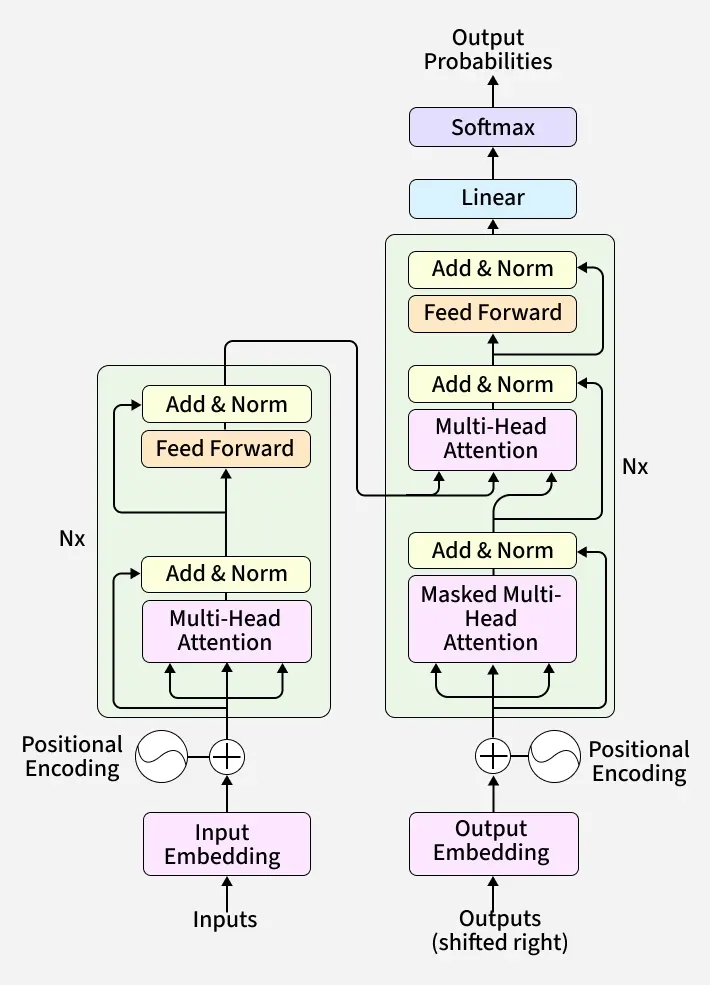 Transformer
The key insight: scale + parallelism unlocks capabilities impossible with sequential RNN-based models.
#Stage 4 — Transfer Learning
Timeline: 2017
A paradigm shift in how models are built. Rather than training a new model per task, a single model is:
- Pre-trained on massive general-purpose text corpora to learn broad language understanding
- Fine-tuned on smaller, task-specific datasets for downstream applications
Key Models
| Model | Organization | Year | Approach |
|---|---|---|---|
| ELMo | AllenAI | 2018 | Contextual embeddings via BiLSTM |
| BERT | 2018 | Encoder-only, masked language modeling | |
| GPT | OpenAI | 2018 | Decoder-only, autoregressive |
| GPT-2 | OpenAI | 2019 | Scaled GPT, zero-shot transfer |
Impact
Transfer learning democratized high-performance NLP — teams no longer needed enormous compute budgets to build capable systems. Fine-tune a pre-trained model in hours, not months.
#Stage 5 — Large Language Models (LLMs)
Timeline: 2020
The natural consequence of scaling transformers + transfer learning. Models with billions of parameters, trained on internet-scale data, began exhibiting emergent capabilities — reasoning, summarization, code generation — that were never explicitly trained for.
The Scale That Changed Everything
GPT-1   →   117 Million parameters   (2018)
GPT-2   →   1.5 Billion parameters   (2019)
GPT-3   →   175 Billion parameters   (2020)  ← Landmark moment
Emergent Abilities
Capabilities like few-shot learning, chain-of-thought reasoning, and code generation emerged purely from scale — not explicit supervision. This was unexpected and transformative.
#The Finale — ChatGPT
Timeline: 2020
ChatGPT is not simply a bigger GPT model — it is GPT refined for human interaction through deliberate alignment techniques.
Three Key Modifications
1. RLHF — Reinforcement Learning from Human Feedback
Base GPT  →  Generate Outputs  →  Human Rankings
                                        ↓
                              Train Reward Model
                                        ↓
                          Fine-tune GPT via PPO (RL)
                                        ↓
                              Aligned ChatGPT
Human raters compare and rank model responses. These rankings train a reward model that guides the LLM toward more helpful, accurate, and safe outputs.
2. Improved Context Retention
Better handling of multi-turn conversations — the model tracks what was said earlier in a dialogue, making interactions feel coherent and natural rather than stateless.
3. Safety Guidelines
Explicit training to refuse harmful, unethical, or misleading requests — making the model not just capable, but aligned with human values.
| Base GPT | ChatGPT |
|---|---|
| Predicts next token | Optimized for helpfulness |
| No conversation memory | Multi-turn context aware |
| Can produce harmful outputs | Safety-aligned via RLHF |
| Raw capability | Capability + alignment |
The entire journey of LLMs is a relentless effort to help machines understand context — from fixed vectors → attention weights → self-attention → pre-training → human feedback. Each stage solved the limitations of the last.
Encoder-Decoder  →  Attention  →  Transformers  →  Transfer Learning  →  LLMs  →  ChatGPT
     (2014)           (2015)         (2017)             (2018)           (2020)    (2022)